Productivity. What is it? Can it be measured? Should we bother?
Tag: Metrics Design
The Potency of Recency
Think of an event.
The event could be anything, whether desirable or undesirable. An A&E arrival, an earthquake, a handbag sale, a property viewing, a virus infection, a death.
When did that event last happen? And is the time since that event happened typical, predictable or exceptional?
Asking these questions can yield deep insights about a system and its processes. The elapsed time between two events is a property of a system which is often invisible.
We sometimes use inter-event timing when talking about Mean Time Between Failures (MTBF) in engineering or cycle & lead times in manufacturing.
The concept of recency goes beyond this and arises in many, many systems. It is fundamental to understanding flow and variability of work and seeking ‘profound knowledge’ as W. Edwards Deming might say.
It is easy to think of the rate of events within some time period eg. orders per month, appointments each week as having similar value. But counts of things over some time period are aggregated measures of throughput which serve a different purpose.
Taking a rate such as 10 transactions over a minute and inverting with 1/rate we get a frequency of 1 transaction every 6 seconds. But this time is a mean average with an implicitly smooth inter-arrival time. What if those transactions all happened in the first 20 seconds, followed by 40 seconds of nothing?
Recency is a measurement which reveals this insight; the variability of the time between events, the essence of flow. We can use it to see short term bursts or droughts of work and whether or not these are predictable.
Why does this matter?
Many processes form a network of queues with a long run behaviour governed by Little’s Law. When capacity is occupied by work in a process, new work has to wait in a backlog to be serviced. Transient bursts of work may consume capacity quickly, forcing new work to wait longer. This converts a variation in arrival rate into a variation in queuing delay. These delay spikes may now produce an inconsistent user experience which is far from an expected distribution.
Flow systems may deal with this unpredictability using a pull model, admitting work at a constant rate, a ‘Takt Time’. With perfect flow, work is pipelined without waiting anywhere, moving through a process without ‘touching the sides’. The amount of work in each part of the process never exceeds some manageable ‘WIP’ limit, allowing capacity to be optimised, balanced to act on the work.
Recency isn’t a commonly used or accessible term. Expressing the measure as an ‘inter-event time’, ‘time between events’ is more descriptive. The words ‘cadence’, ‘beat’, ‘pulse’ or ‘rhythm’ might be more suitable in some settings.
Perhaps just as important is the interpretation of these inter-event timings. By far the most powerful method is visualisation in a line chart, preferably with statistical control lines. An XmR chart is the ‘swiss army knife’ choice but a Mean or median X-bar chart works too.
Each event is a discrete category on the X-axis, as a sequentially numbered item or, more usefully a date. The elapsed time in suitable units between each event and the next one is then plotted on the Y-axis, joined by a line. Here, unless there’s a difference between the date/time stamps for each event, the recency Y-value will be zero. A central line and upper/lower process limits are then computed for the Y-values.
There will be natural gaps in the recency of work such as overnight and weekends which might lead us to mask out non-working time from this chart. High volumes of events can be more difficult to plot too.
Through the lens of recency, we can see why batches are the enemy of flow. A batch produces work items which are spaced at shorter intervals, followed by a longer interval until the next batch. Revealed through an XmR chart, the process behaviour can flap alarmingly out of statistical control. Its easy to see why absorbing and handling this pumping demand in a predictable way is so challenging.
A really useful technique is to use XmR charts look at recency in different parts of a process such as a customer journey. At any process steps where the recency and its variability are shifted, queues will form, however transient. Bottlenecks will be immediately visible, much like a backlog on a Kanban board. Jump plots are another way of revealing this in a visual way. Comparing histograms can be instructive too, revealing different pulse ‘modes’.
Example – Health
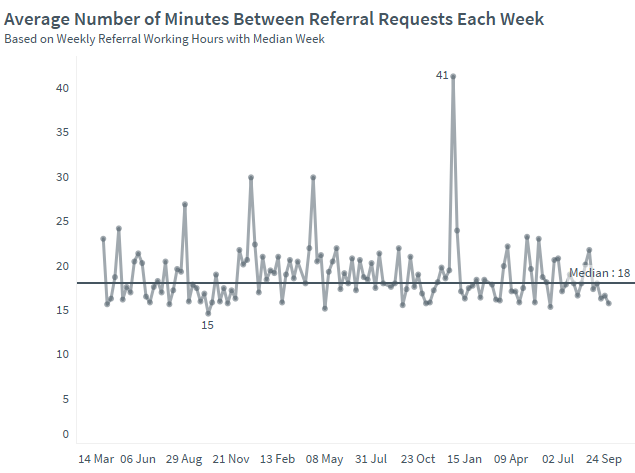
A health provider had an overall referral recency of one every 18 minutes. Stratifying this recency was revealing both in terms of which service had the most arrival intensity but also variability. This brought focus to how often a person needed to be triaged by each service as well as thinking about ways of smoothing demand. Holding more frequent admissions team meetings was one option, another was to ‘pull’ a pulse of referral demand every day from the most predictable source.
Example – Property
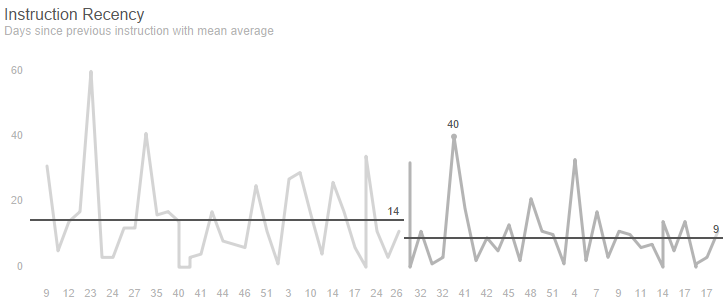
An estate agency had appointed a new branch manager and wanted to understand whether the branch was now winning more property listings and market share. The number of days since the previous instruction was used to detect a positive shift from an instruction every 14 days to one every 9 days.
Transformation Translation
‘Transformation’ must be near the top of the list of the most over-used business language. It sounds so grandiose and yet has no universal meaning. Read more
KPI Traps – Can You Avoid Them?
Yes, measurement is vital for reducing uncertainty and monitoring improvement but its easy to get wrong.
Watch out for these traps and avoid the dark side of KPI dysfunction … Read more
Seeing a Silent IT Transformation
When an IT function set out to transform itself from an ugly duckling into a swan it wanted to make its ‘Silent IT’ strategy visible to the business.
Seeing the Value of EU Law
I was very proud to present my Subsidiarity Scoreboard work at the ECR Group Study Week in Krakow, Poland.
I was inspired by the people I met, especially those MEPs who are so passionate about their work and their dedicated policy advisers. I’m fascinated by the tension between ideological belief and evidence, claim and fact and this is the world they wrestle with daily.
My talk was about Seeing the Subsidiarity Gap; the idea of a scoreboard for making the gap between the predicted and actual added value of EU law more visible. Publishing this Scoreboard could influence the reform of lower value EU laws and even the legislative process itself. Watch the talk below.
I was however struck by another kind of gap; the gap between my own mental models and those immersed in EU law, economics and politics. And yet, in spite of this difference in mindsets and worldviews, how Systems Thinking can be a unifying approach however challenging the domain and context.
The study, sponsored by the New Direction Foundation for European Reform, is described in a bit more detail in the case study.
BRAND Performance
Client: BRAND
Company Type: Reputation Management Consultancy
To understand weaknesses within the business and introduce time management performance measures.
Measuring the Local Value of EU Law
Client: NEW DIRECTION – The Foundation for European Reform
Company Type: Non-profit Think Tank
To develop ideas for a Scorecard for measuring the local value of EU law.